
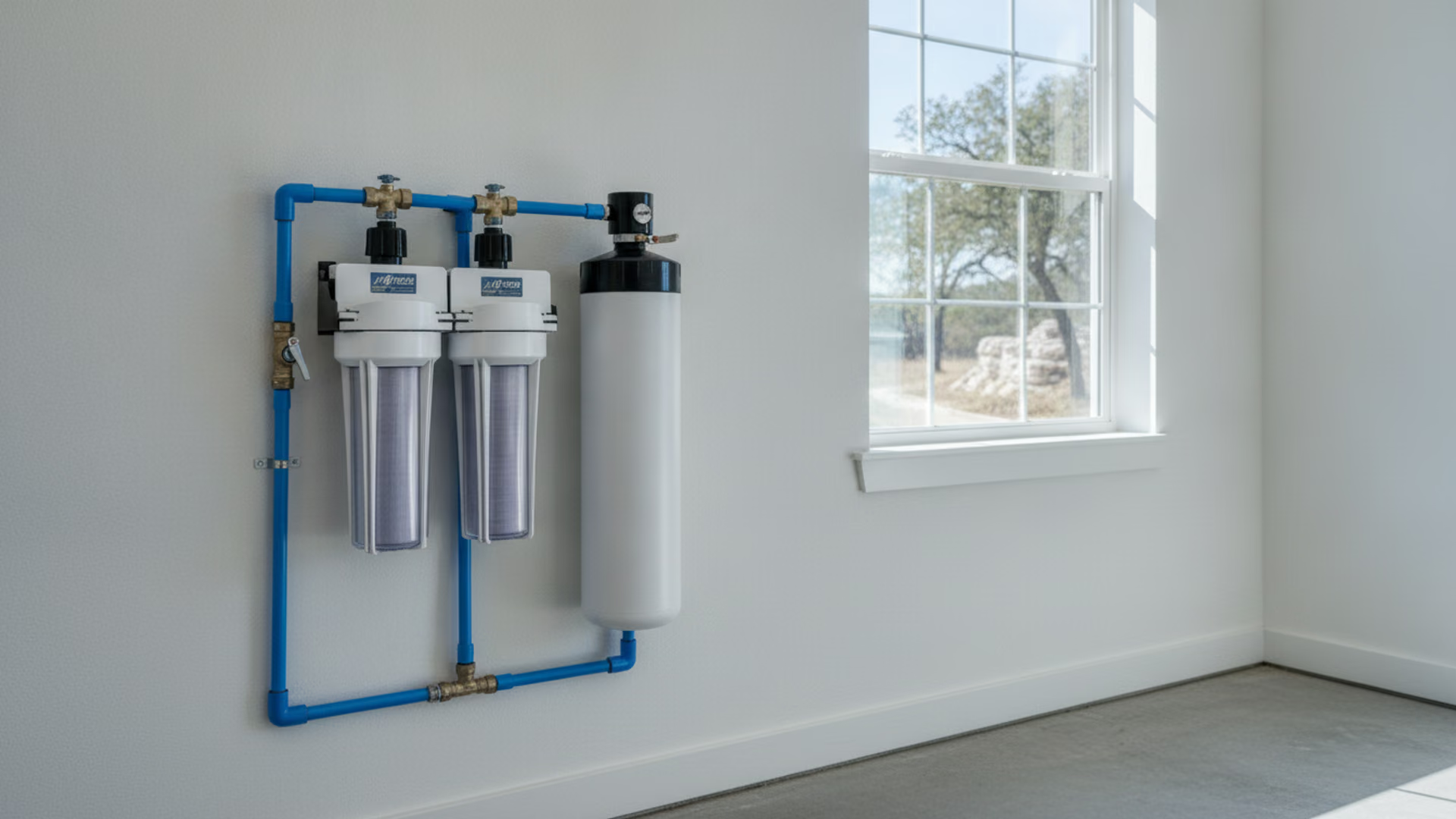
A water filtration system in Austin and the Hill Country takes the pool smell, the chemical taste and the grit out of treated city water: a sediment prefilter and the right kind of carbon filter, installed where water enters the house. It is the everyday fix when your tap water smells like a pool as you fill a glass, the coffee has a chemical edge, or you unscrew a faucet aerator every few months and find gritty stuff packed into the screen (and it has almost nothing to do with whether the water is safe). Austin Water, Cedar Park, Leander and the lake-fed districts between them all meet federal and TCEQ standards. What you are noticing is the treatment itself: chloramine disinfectant, and sediment stirred up in the mains. The fix is a sediment prefilter and the right kind of carbon filter where water enters the house, and Absolute Water Solutions has installed them from Spicewood since 2003, and every job starts with a water test rather than a guess.
What's in city water around Austin (and why it smells like a pool)
Most of the larger utilities in our area draw from Lake Travis or Lake Austin and disinfect with chloramine, a blend of chlorine and ammonia that holds its strength through long distribution mains better than free chlorine does. Austin Water's 2025 report shows an average of 2.3 ppm in the distribution system; Cedar Park runs higher at 3.09 mg/L and Leander averages 2.40. Chloramine does not off-gas the way chlorine does, so a pitcher in the fridge never fixes the smell and an ordinary carbon pitcher barely dents it.
Once a year the taste changes on purpose. The BCRUA cities (Cedar Park, Leander and Round Rock) and Liberty Hill, which buys Leander water, switch to free chlorine for a "chlorine rinse" (Aug 3 through about Sep 1 in 2026) and warn residents to expect a pool-like taste for the month. Warm late-summer lake water also raises disinfection byproducts: Cedar Park's 2024 TTHM samples hit 97.8 ppb on individual draws against an 80 ppb running-average limit, though the utility stayed compliant on the average. None of this is a safety issue. It is a taste, odor and byproduct problem, which is exactly what carbon is for.
Occasional one-off events play a part too. Austin's February 2019 zebra-mussel die-off inside a raw-water main drew 2,451 complaints of fishy, pond-water tap water, and each of the three citywide boil notices (October 2018, February 2021, February 2022) ended with flushing that pushed sediment into home plumbing. Main breaks in Cedar Park and Leander do the same on a smaller scale.
Sediment filtration: the gritty stuff
The gritty stuff in the aerators is usually one of three things: pipe scale and rust knocked loose in the mains after a break or a hydrant-flushing cycle, fine silt that slipped through the plant during a turbidity spike, or flakes of calcium carbonate shed by your own water heater. A sediment prefilter catches the first two before they reach fixtures, the softener or an RO membrane; if the grit is coming from the heater, the test tells us and the fix moves to the hot side.
Sediment filters are rated in microns, and the rating matters more than the brand. A spin-down filter with a stainless screen, typically 50 to 100 mesh, handles coarse sand and flushes by opening a valve. Behind it, a pleated or string-wound cartridge at 20 microns handles visible grit; a 5-micron cartridge catches silt. Tighter than the water needs just drops your pressure and shortens cartridge life, so we match the micron rating to what the test and the aerator screens show, and size the housing for the home's flow. Usually a 4.5-by-20-inch housing on a whole-home line so a shower and a washer can run together without a pressure drop.
Carbon filtration: chlorine, chloramine and taste
A carbon filter works by adsorption: chlorine, byproducts and the organic compounds behind earthy lake taste stick to the enormous internal surface area of activated carbon. Standard granular activated carbon (GAC) handles free chlorine easily. Chloramine is different, because the chlorine-ammonia bond has to be catalytically broken before the carbon can hold it, and plain GAC does that slowly and exhausts fast. Catalytic carbon is activated carbon with a surface modified to speed up that reaction, and it is the correct media for every chloraminated utility we serve. Plain GAC on Austin water works for a few months, then the pool smell tends to return while the cartridge still looks fine, which is why we choose catalytic.
Carbon block cartridges pack the carbon into a solid tube rated as fine as 0.5 micron: excellent at the kitchen tap, restrictive on a whole-home line. KDF media, a copper-zinc alloy, is sometimes blended ahead of carbon to knock down free chlorine and extend carbon life, but it does not treat chloramine on its own. Contact time is what makes any of it work, so we size carbon by flow rate: a tank that is right for a two-bath house will let chloramine slip through in a five-bath house with two tankless heaters.
Cartridge housings vs backwashing tanks
Worth knowing
There are two ways to hold that media, and the choice comes down to gallons per day and maintenance appetite. Cartridge housings are compact, inexpensive to install and easy to service: unscrew the sump, swap the cartridge, done. They suit smaller homes, lighter chloramine, and anyone who wants a sediment prefilter ahead of an existing softener or reverse osmosis system.
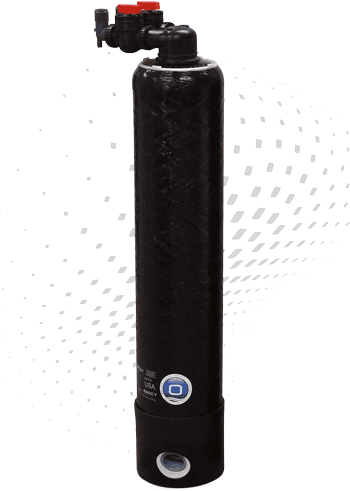
A backwashing carbon tank holds a cubic foot or more of catalytic carbon in a mineral tank with a control valve on top. It gets far more contact time, handles higher flow, and periodically reverses flow to lift and rinse the bed so channels do not form. It needs a drain and an outlet, and the media is replaced every few years instead of every few months. For a larger Austin-area home on chloraminated water, this is usually the unit that makes the smell go away and stay away. When the job also calls for softening or UV, the integrated point-of-entry design and its cost ranges live on our whole-house water filtration systems page.
Filtration vs purification vs softening
These get used interchangeably and they are three different jobs. Filtration strains particles and adsorbs chemicals: sediment, chlorine, chloramine, taste and odor. Purification makes water microbiologically safe, which on a well or a lake intake means UV or chlorination; that is our water purification work. Softening exchanges calcium and magnesium for sodium so scale stops forming on fixtures and heaters; a carbon filter does nothing for hardness, and a softener does nothing for the pool smell. Polishing drinking water (fluoride, sodium, byproducts, dissolved solids) is a fourth job for a kitchen reverse osmosis system, which itself needs catalytic carbon ahead of the membrane on chloraminated water.
Keeping filters working
Filtration only works while the media has capacity. As a rule of thumb, sediment cartridges get changed every three to six months (sooner after a boil notice or a main break), carbon cartridges every six to twelve months, and a backwashing carbon bed every three to five years depending on chloramine level and gallons used. A returning smell says the carbon is done long before the cartridge looks dirty. We write the intervals on the housing at install, and a repeat water test is the honest way to confirm the carbon is still catching chloramine rather than just looking clean.
Where we install filtration
We are based in Spicewood and install sediment and carbon filtration across the lake-fed cities on both sides of Lake Travis: Austin, including the west-side districts that do not lime-soften; Leander and Cedar Park on BCRUA water; Lago Vista on the north shore; and Marble Falls on the Highland Lakes. Private wells and raw lake intakes need a different filter train; those are covered on our well water and surface water pages.
We schedule visits during business hours, Monday through Friday, 8am to 5pm. Call (512) 587-8188 or request a free estimate, and tell us what you are smelling and what you are finding in the aerators. That is most of what we need to know before the test.