
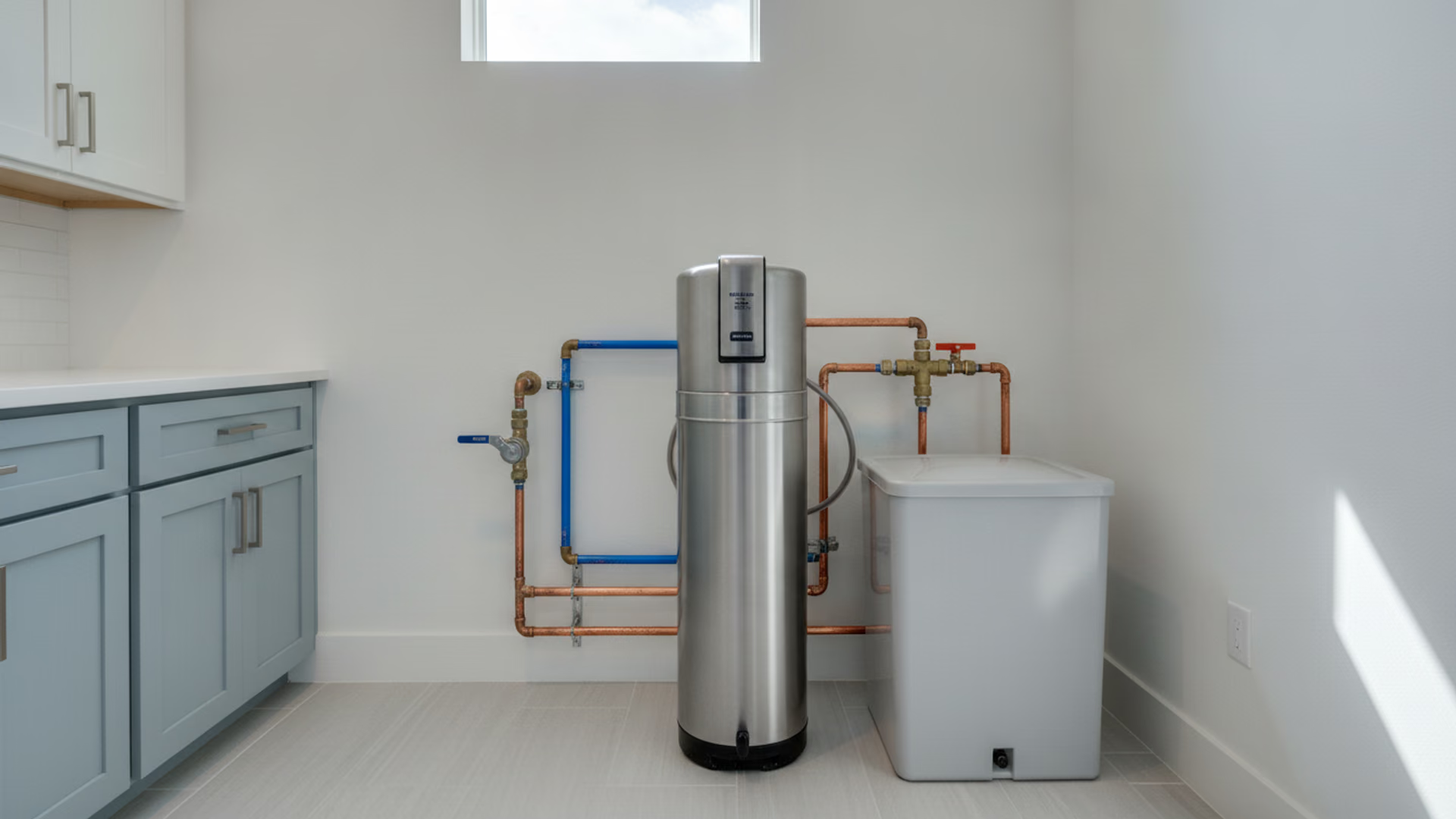
Water softener installation in Austin and the Hill Country is a large share of what Absolute Water Solutions has done since 2003, and a correctly sized softener is the straightforward answer to hard water. It takes care of the white crust on the faucets that returns a week after you clean it, a cloudy shower door, spots on the dishes and glasses whichever rinse aid you buy, a half-plugged showerhead, and the flow error a tankless water heater shows every few months when scale builds up. All of that is limestone. Nearly every tap from Austin's west side out to the Highland Lakes runs Colorado River water that spent its life over Edwards and Trinity limestone, and calcium carbonate is what it carries.
We test your water first, size the unit from the actual number, and install it ourselves, no subcontractors. If you have been searching for a water softener in Austin, the number is the right place to start. There are two of them.
How hard is the water here? Two numbers, not one
"Austin has soft-ish water" is partly true, and only inside Austin Water's retail area. Austin Water lime-softens at its three plants; its 2025 water quality report shows total hardness of 70 to 126 mg/L, averaging 93 mg/L, which is 5.4 grains per gallon, "moderately hard." The detail worth knowing is what lime softening leaves behind: finished water at a pH near 9.7, which is scale-forming even at moderate hardness. That is why homes in Circle C, Lost Creek and Great Hills still get chalk on aerators and inside tankless heat exchangers.
Step outside Austin Water's lines and the number roughly doubles. The districts that treat raw Lake Travis water without lime softening report 10.7 to 11.3 gpg in their own reports: Travis County WCID 17 (Steiner Ranch, Flintrock) at 185 mg/L, Lakeway MUD at 184, Cedar Park at 183, Leander at 194. Membrane filtration takes out particles, not calcium. Trinity wells west and south of the lake commonly come in harder still, and if a well also carries iron, that iron fouls softener resin: it needs iron removal ahead of the softener, not instead of it.
Rather than guess where your house falls, every job starts with a hardness test at your tap, and the number gets written on the valve. The district-by-district figures are laid out in Does Austin have hard water?
How a water softener works
Ion exchange. Inside the tall mineral tank is a resin bed (one to three cubic feet of polystyrene beads charged with sodium ions). Hard water passes through, calcium and magnesium stick to the beads, sodium releases in their place, and the water leaving the tank has no hardness minerals left to drop out as scale.
Once the beads are loaded, the control valve runs a regeneration cycle: a backwash to lift and loosen the bed, a brine draw that pulls salt water from the brine tank (the short square tank you pour salt into) through the resin to strip the calcium off, a slow rinse, a fast rinse, and a refill of the brine tank for next time. The used brine goes to the drain and the resin is ready again.
The control valve on top is the whole game. A demand-initiated valve counts gallons and regenerates only when capacity is actually used up. Older timer valves regenerate on a clock (2 a.m. every third night whether you used 50 gallons or 500) and waste salt and water doing it. The bypass valve on the head lets you send water around the softener without shutting off the house, and it is worth knowing where it is.
Sizing: grains per gallon times household use
Capacity is measured in grains. The arithmetic: hardness in gpg, times people, times roughly 75 gallons per person per day, equals grains removed per day. A family of four on Leander water at 11.3 gpg pulls about 3,400 grains a day, roughly 23,700 a week. A nominal 32,000-grain unit (one cubic foot of resin) would regenerate about weekly, but only at its maximum salt dose, which is the least efficient setting a softener has.
So we generally size up: a 48,000- or 64,000-grain unit, 1.5 to 2 cubic feet of resin, regenerating every 7 to 10 days at a lower salt dose. Resin does more work per pound of salt when it is not pushed to its limit, and a larger bed keeps up when a tankless heater and two showers run at once. Flow rate matters as much as grains: a softener that is too small for a 3,500-square-foot house with three bathrooms lets hardness slip through at peak flow. Tell us people, bathrooms, water heater type, and whether a pool fill or irrigation runs off the softened line.
Salt-based softener vs salt-free conditioner
A salt-free conditioner (template-assisted crystallization) does not remove calcium. It converts it into crystals that are less inclined to bond to pipe and heater surfaces. It needs no salt, no drain and no electricity, and on some water it helps with heater scale. It does nothing for spots on glass, soap lather, or dry skin, because the calcium is still in the water. A softener removes it.
For 10-to-11 gpg lake water in a house with a tankless heater and frameless glass showers, we recommend softening. For a septic lot where the owner wants no brine at all, a conditioner is an honest compromise, and we say so. Water softener vs water conditioner covers the tradeoffs in detail. Softeners also pair with catalytic carbon for chloramine and lake taste in one whole-house system.
Water softener repair and replacement
Worth knowing
Most water softener repair calls sort into a handful of familiar issues, each with a clear sign and a known fix:
- The water went hard again, and the salt level has not moved in weeks. A salt bridge is a crust across the brine tank above the waterline while the salt beneath it dissolves away. The valve regenerates on schedule but draws plain water. Break it with a broom handle; if it keeps forming, the tank is being overfilled or the garage is humid.
- Salt is disappearing fast, or the unit runs constantly. The valve is stuck in a regeneration position: worn piston seals, a clogged injector, a failed drain line flow control, or a worn-out motor. This is also the usual cause of an overflowing brine tank.
- The water tastes salty for an hour after regeneration. Brine is not rinsing out fully. Look for a partially clogged injector or drain line, or low pressure during the rinse.
- Soft water, but pressure has dropped everywhere. Resin that has fractured or fouled (years of chloramine, or iron on a well) or a cracked distributor tube pushing resin beads into your plumbing. Beads in the aerators confirm it.
Resin has a service life: roughly 10 to 15 years on chloraminated municipal water, less on a well with iron. The builder-grade softeners in the 2010s subdivisions around Leander, Cedar Park and Bee Cave were typically a small resin bed on a basic valve with no prefilter, and many are now reaching the end of that life. We rebuild valves, rebed resin, and replace units, and when the valve is past 12 years and the resin is original, we tell you a rebuild usually costs close to a replacement.
Softeners on septic, and the lake-district rules
Texas never banned water softeners (that rumor is California's). What Texas did in 2003 was pass SB 1633, now Health and Safety Code section 366.013: a softener that discharges into a septic system must use a demand-initiated regeneration control, labeled as such, and a timer unit must be replaced with a DIR unit when the septic system is replaced. That covers Old Lakeway, The Homestead in Bee Cave, the Nameless Road acreage west of Leander, and most of Spicewood. The City of Austin's plumbing code goes further: DIR control required, and no more than 4 gallons of regeneration water per 1,000 grains of hardness removed, with a plumbing permit on the install.
Everything we install meets both rules, and on a drainfield in thin limestone soil we set the salt dose and reserve so the regeneration volume reaching the tank stays as low as the chemistry allows.
Where we install
We are based in Spicewood, so Lakeway and Bee Cave are a short drive, Austin's west side is 20 to 30 road miles, and Cedar Park and Leander are 30 to 35. In Austin the work splits by utility: Steiner Ranch and Barton Creek sit on unsoftened district water near 10.7 gpg, while Austin Water neighborhoods are moderately hard but high-pH, so the job is usually about protecting a tankless heater. The Lakeway utilities that publish a hardness figure all report roughly 10.7 gpg lake water. Bee Cave's supplier publishes no hardness figure, so we test on site rather than quote one. Lago Vista on the north shore is the same limestone lake water. We serve residential and light commercial customers and schedule every visit during business hours, Monday through Friday, 8am to 5pm.
When you are ready to be done with the crust on the faucets, call (512) 587-8188 or request a free estimate. Bret will test the water, give you the number, and quote the unit that fits it.