
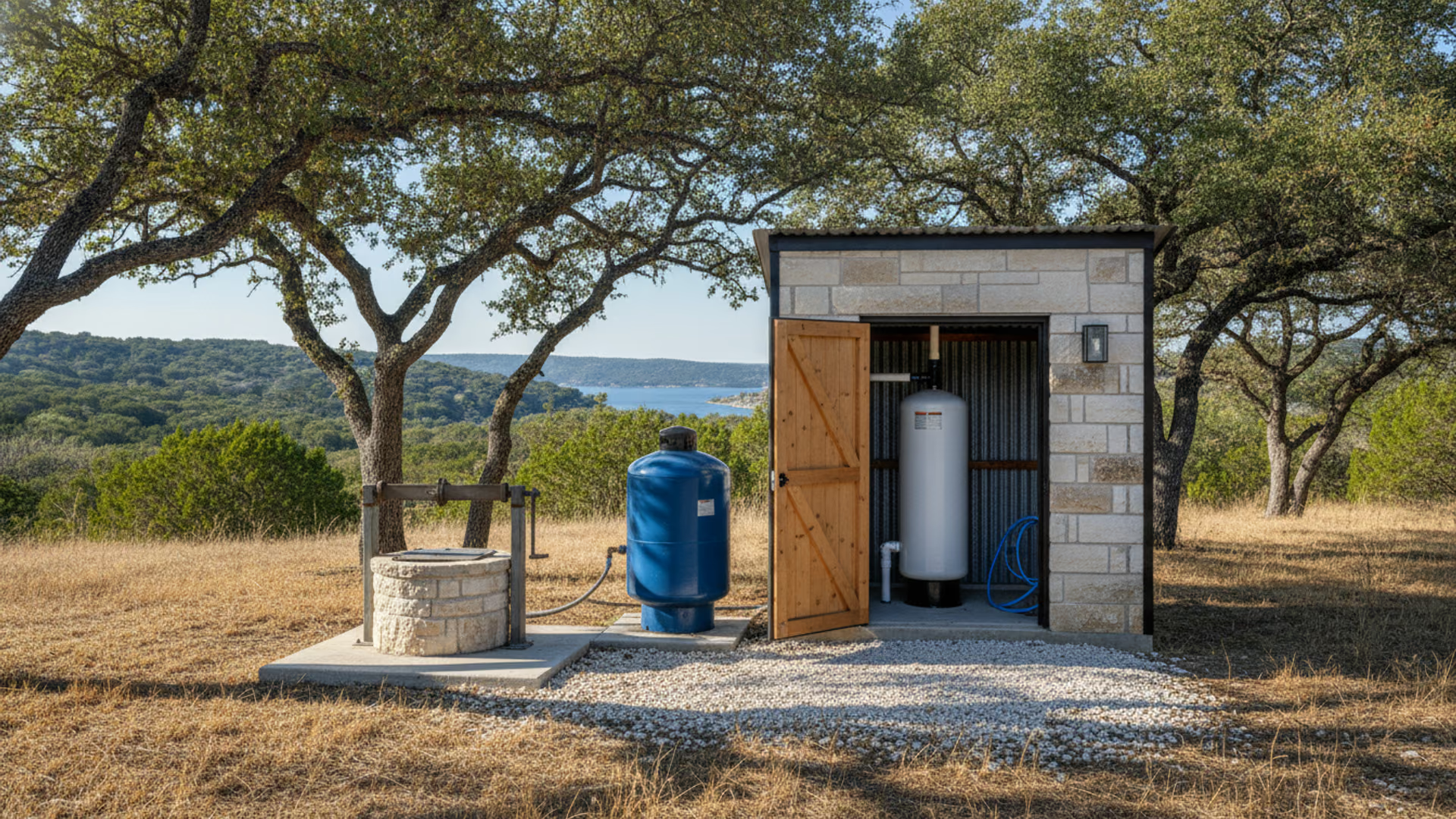
Well water treatment in the Hill Country means building the right set of stages for what your particular well brings up. Usually that is ordinary stuff: sand in the kitchen faucet aerator a couple of days after a big rain, water hard enough to scale a water heater in five years, an orange tint in the tub, a whiff of sulfur off the hot tap. Sometimes it is a lab result: if a well test came back positive for coliform, that is common after storms and very fixable, with a clear sequence for sorting it out.
That is the work. It is rarely just one problem; it is whatever your particular hole in the limestone is bringing up this season. Absolute Water Solutions has been building well-house systems out of Spicewood since 2003, and the approach has not changed: test what is actually in the water, then build the treatment train the test calls for. Nothing more.
What a Hill Country well is actually pulling up
Water quality on a private well is up to the owner, and it is easy to keep on top of. The groundwater districts (Hays Trinity, Blanco-Pedernales, Southwestern Travis County, Central Texas) manage how much gets pumped rather than what comes out of your tap, and western Williamson County has no district at all after the Clearwater board voted down annexation in February 2024. TCEQ's guidance is a simple annual bacteria and nitrate test, a good habit that many well owners we meet have not started yet.
Most wells from Dripping Springs to Spicewood to Liberty Hill are finished in the Trinity aquifer: the Middle Trinity (Lower Glen Rose, Hensell sand, Cow Creek limestone) or, increasingly, the deeper Lower Trinity below the Hammett shale. On the Llano Uplift side (Round Mountain, northern Blanco County, Marble Falls), deeper wells hit the Ellenburger-San Saba dolomite, and a few around Cypress Mill tap the Marble Falls limestone. These are deep holes: documented wells on Nameless Road on the Leander fringe run 635 and 650 feet, and a Hays County driller reported static water levels sitting at 660 to 690 feet in March 2026, against roughly 500 feet historically. Very little of any given rain ever reaches water that deep, which is why a wet spring does not refill a well.
What that water carries is fairly predictable:
- Hardness, almost always. A USGS survey of 480 Blanco County wells found 467 "very hard." The Blanco-Pedernales district calls Ellenburger water inherently hard; Trinity water is the same story.
- Sediment and sand after rain, or when a pump is chasing a falling water table.
- Iron, manganese and hydrogen sulfide. Iron exceeded 0.3 mg/L in 45% of the Blanco County wells sampled for it; sulfate from the Glen Rose gypsum beds ran over 250 mg/L in 18%.
- Coliform bacteria, especially in karst wells after a flood, and nitrate near livestock (over 45 mg/L as nitrate in 20% of the Blanco County samples).
- Radium and gross alpha in some Trinity wells. Liberty Hill's own Hensell wells tested 3.8 pCi/L combined radium in 2022, 76% of the federal limit.
- Rising TDS and salinity as drought pulls levels down; the Middle Trinity runs over 1,000 mg/L TDS across much of the Onion and Barton Creek watersheds.
Testing first: what we look for
Every recommendation starts with a water test. In the house we check hardness, TDS, pH, iron and what the sediment actually is: sand, silt and rust flakes off the casing tell three different stories. Bacteria, nitrate and radium go to a lab. If you are buying a place on a well, do this before closing; after a flood, a retest once the water settles is good routine practice. The water testing page explains what gets measured and how to read the results.
The well-house treatment train
Worth knowing
Well water filtration is built in stages, in a fixed order, and every stage protects the one after it:
- Pressure tank first. Everything downstream is sized to your pump's flow and the pressure tank's draw-down, not to the number of bathrooms. A 40/60 switch on a 10 gpm pump behaves very differently from a low-yield well feeding a cistern.
- Spin-down filter. A clear-bowl screen that catches sand and grit and flushes with a valve turn. It's the first thing to install when the water is cloudy or sandy.
- Cartridge sediment filter. Five-micron polishing so the media beds and UV lamp downstream see clear water.
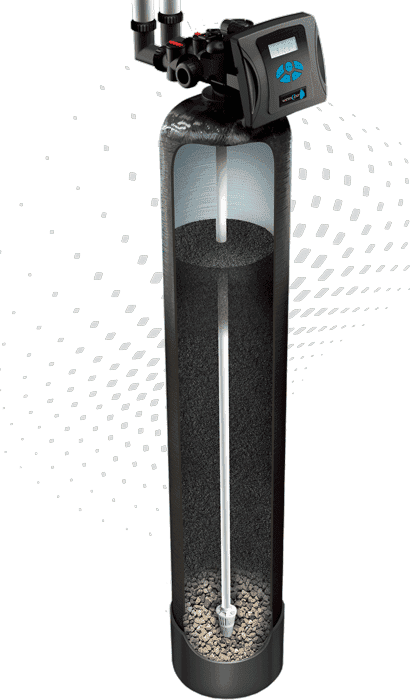
- Softener or conditioner for the hardness that is the baseline on every Trinity and Ellenburger well.
- Iron or sulfur filter if the test shows it (the air-injection or oxidizing stage), covered in depth on the iron and sulfur removal page.
- UV for disinfection.
- Reverse osmosis at the kitchen for TDS, sulfate, fluoride, radium and taste.
That is the ceiling, not the standard package. Plenty of wells need stages two, four and six and nothing else. The order matters more than the count: a backwashing filter needs more flow than the house does, and a UV lamp cannot disinfect water it cannot see through.
Softening well water, and why iron matters
A well water softener is sized in grains per gallon against the tested hardness and the pump's flow, not off a chart. Two things are different on a well. First, iron: dissolved iron fouls softener resin over time, so if the test shows more than a trace, an iron stage goes ahead of the softener. Second, septic: nearly every well home is also on an OSSF, and Texas Health and Safety Code 366.013 only allows softener discharge to a septic system from a demand-initiated regeneration (DIR) unit. That is what we install. One more distinction worth knowing: a rotten-egg smell that only shows up on the hot side is usually a water-heater anode reaction, not the well. The rotten eggs article walks through telling the two apart. Softener sizing and repair in general live on the water softeners page.
Bacteria: UV and chlorination
If a well test came back positive, the sequence is straightforward: boil or use bottled water for drinking and cooking, shock-chlorinate the well and the plumbing, retest, and then decide on permanent disinfection. We install Viqua UV systems, always behind a five-micron sediment filter and, where hardness would coat the quartz sleeve, behind the softener. UV is the right answer for a well that tests positive after floods or a sanitary-seal problem. For wells with persistent contamination or heavy iron, a chlorination feed with a contact tank is the other route. The depth on disinfection lives on the water purification page. A positive result is not something we can promise to rush. We schedule the earliest business-day visit we have and get you through the boil-water period with a plan.
Low-yield wells, drought and floods
Typical Blanco County yields are 10 to 25 gpm; Ellenburger wells range from 3 to 45. In the 2011 drought and again in 2022-23, some wells stopped producing and owners lowered pumps across the region. The Hays Trinity district has been in its most severe drought stage since September 2024 with a 40% curtailment, and March 2026 monitoring showed the worst aquifer levels in twenty years. A pump chasing a falling water table pulls sand and air, and a low-yield well cannot backwash a media filter. The fix is a storage cistern with a float switch and a booster pump: the well fills the tank slowly, and the booster gives the treatment train the flow it needs. Then the July 2025 floods came, and the first big rain after a drought is when karst wells are most likely to go cloudy or test positive, so a retest after an event like that is simply good routine.
Well country we serve
We work wells across the Dripping Springs acreage subdivisions like Hidden Springs Ranch and Sunset Canyon, the Ellenburger and Trinity wells around Johnson City and Round Mountain, our home ground in Spicewood, Briarcliff and Highland Lake Estates, and the two-acre-minimum well-and-septic lots west of Liberty Hill. Same test-first process, same installer: Bret, with 1,000-plus systems behind the company since 2003.
Whether it is sand in the aerator, hard water, or a lab report you would like a second pair of eyes on, call (512) 587-8188 during business hours, Monday through Friday, or request a free estimate.