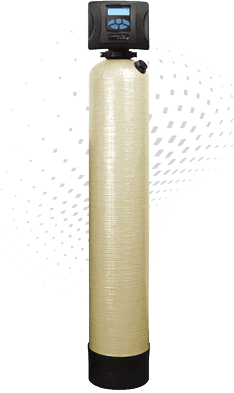
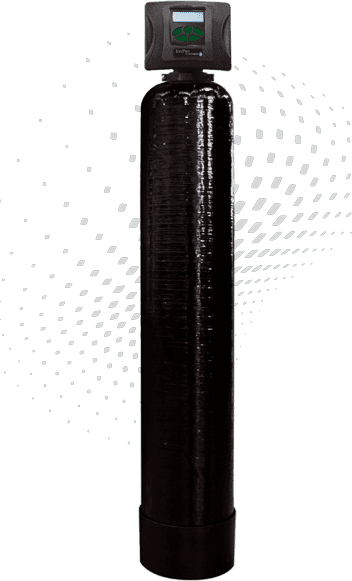
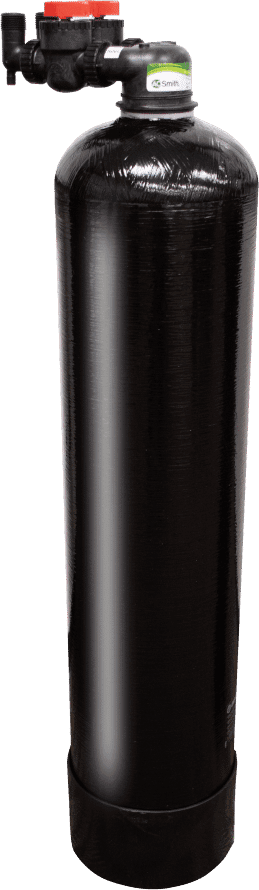
Most of the whole-house filtration Absolute Water Solutions installs comes out of two WaterCare filter lines: CareClear Pro® for city water and most wells, and Ion Pro® for wells that stain and smell. Both mount on the main line as it comes into the house, both clean themselves with nothing but water, and neither goes on the truck until we have tested what is coming out of your tap. How a complete point-of-entry stack gets sized, stage by stage, is on our whole-house systems page.
CareClear Pro®: chlorine, particles and low pH
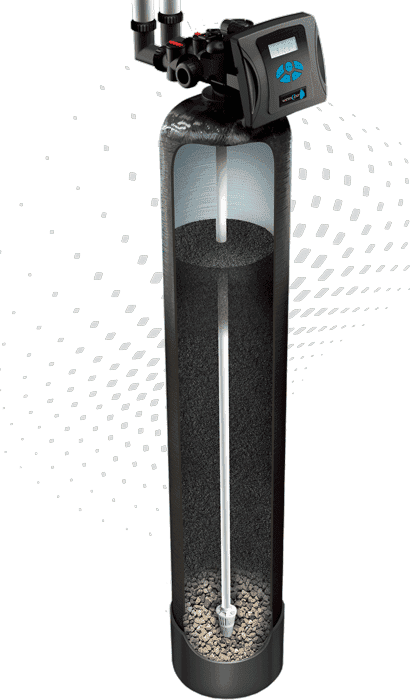
CareClear Pro® is the general-purpose line. WaterCare builds it for city water or well water, and the tank does one of three jobs depending on the media inside:
- Carbon takes out chlorine taste and odor. On Austin Water, Cedar Park, Leander and most of the larger lake-fed districts the disinfectant is chloramine rather than plain chlorine, and chloramine needs a catalytic grade of carbon to come out. The test settles that, and we confirm the media option against the spec sheet before anything is ordered.
- Particulate media catches the sediment that a water-main repair or a hydrant flush sends down the district lines, and the sand a well pump pulls up from the bottom of the casing.
- Acid neutralizer raises the pH of water that is eating at copper and brass, which shows up as blue-green staining and pinhole leaks. Acidic water is uncommon on the limestone aquifers here; where it turns up is on rainwater collection, which starts out with almost no minerals in it.
The control valve monitors your water use and adjusts its cleaning schedule to it, and it backwashes the media using only water. Which filter types belong on municipal water, and in what order, is laid out on our water filtration page.
Ion Pro®: air and media for iron and sulfur wells
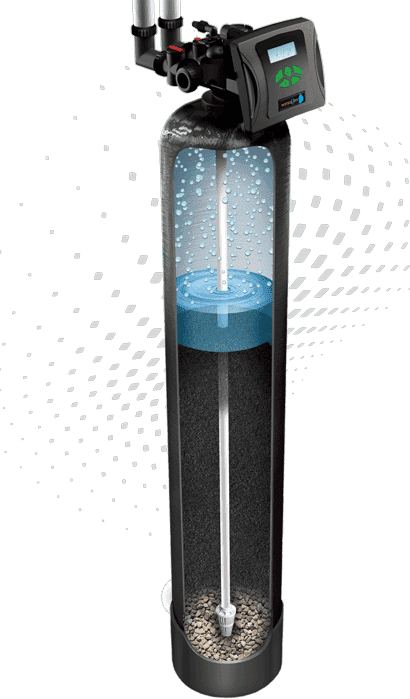
Ion Pro® is the well filter. It pairs an air chamber with a specialized filtration media: the air chamber oxidizes dissolved contaminants like iron and sulfur so they turn into particles, and the media catches those particles before they reach the house. It runs without chemicals or salt, just air, and it uses only the water it needs to keep pressure consistent through the home.
That is the fix for the orange toilet ring, the rust trail down the tub wall below the spout and the rotten-egg smell that comes off a Trinity well or an Ellenburger well. USGS sampling put iron over the 0.3 mg/L staining line in nearly half the Blanco County wells it checked, and the Hickory formation under the Llano Uplift carries iron as a matter of course. Why oxidizing works, and when the smell is the water heater rather than the well, is explained on our iron and sulfur page.
Which one your water calls for
We do not pick between the two from a description of the problem, because the descriptions overlap. Cloudy water can be sediment, air or precipitated iron. A chemical smell can be chloramine on district water or hydrogen sulfide on a well. So the sequence is fixed: test first. At the house we run hardness, chlorine or chloramine, pH, iron and TDS; on a well a sample goes to a lab for bacteria as well. The results say which line, which media, and what tank size the flow rate justifies.
Two things a filter does not do. Neither CareClear Pro® nor Ion Pro® softens water; the 10 to 11 grains of hardness a Lake Travis district delivers unsoftened, or the 20-plus in a Trinity well, still needs a softener behind the filter. And neither one disinfects. A bacteria positive on a well calls for a UV stage, not a bigger filter.
Installation and what it needs from you
Both lines install upstream of the water heater and the softener, so chlorine, sediment and iron never reach the softener resin. The tank needs a drain for its backwash, power for the control valve, and a bypass so the house is never without water during service. In the 2010s garages around Leander, Bee Cave and Cedar Park the builder's loop already has all three; in a Spicewood well house the filter sets beside the pressure tank.
Worth knowing
Upkeep is light. The valve cleans the media on its own, adjusting to how much water the household actually uses, and we program it at startup to the numbers from your test. We show you what to watch, and when a filter does need attention the visit gets scheduled for a weekday between 8am and 5pm.
If your water smells, stains or leaves grit behind, start with the test. Request a free estimate or call (512) 587-8188, and we will size the filter to whatever the test turns up.