
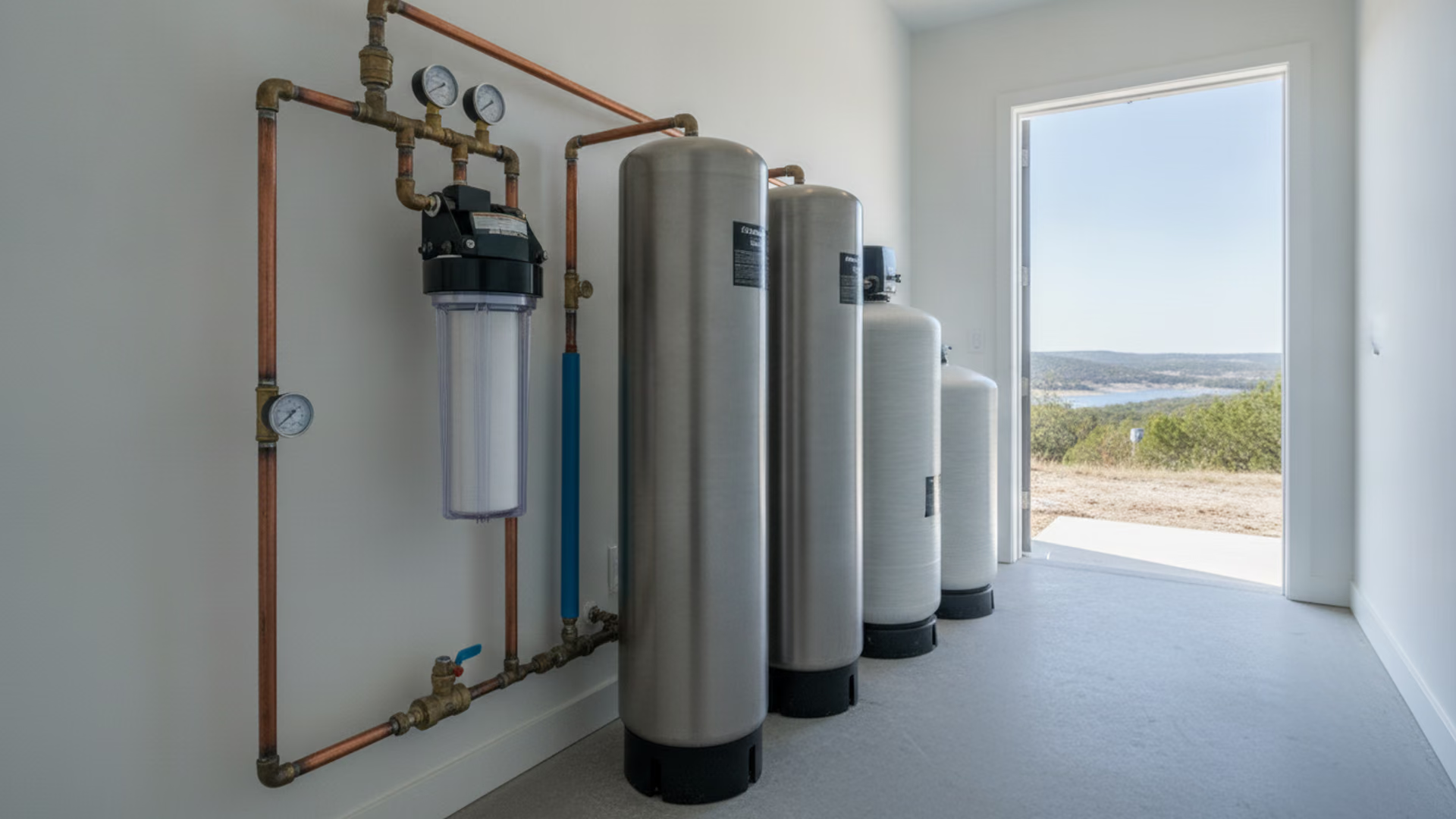
A whole house water filtration system treats the water for your entire home from one place: a point-of-entry unit on the main line, ahead of the water heater, so every tap in the house gets treated water instead of just the kitchen faucet. It is the natural fit for Lake Travis homes on hard, chlorinated lake water, and it addresses the everyday signs of that water together. Maybe the dishwasher has white film on the glasses whichever rinse aid you use, the showerhead is clogged again a few months after a vinegar soak, or a plumber pointed to mineral scale in the heat exchanger as the reason a water heater died early. Those share one cause: the same water reaching every fixture in the house, and one properly sized system takes care of all of them at once.
Absolute Water Solutions has built these systems out of Spicewood since 2003, with over 1,000 projects and every install done by Bret himself. We are a licensed water treatment specialist (TCEQ license WT001370) and insured. We test first and size the system to what the test finds, not to a package.
What a whole-house system is: point of entry vs point of use
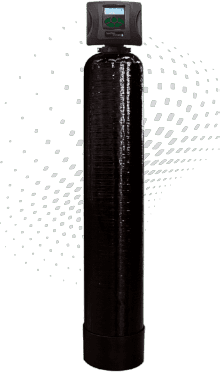
Point of entry (POE) means the system sits where water enters the house (at the main shutoff, on the softener loop in the garage, or in the well house) and treats everything downstream: showers, laundry, the water heater, the dishwasher, the ice maker. Point of use (POU) treats one tap; a reverse osmosis unit under the kitchen sink is the classic example.
The two are not competitors. A whole-house system protects plumbing and appliances and fixes what you feel in the shower; an RO at the kitchen finishes drinking water to a level no point-of-entry system reaches economically. Most Lake Travis homes end up with both, and the RO lasts longer because the stages ahead of it have already pulled the sediment, chlorine and hardness that wear out an RO membrane.
The stages, in order
Water passes through the stages in a fixed order because each one protects the next.
- Sediment prefilter. A spin-down or pleated cartridge catches sand, silt and the rust that main breaks and hydrant flushing push through district lines. On a well it is not optional.
- Carbon: catalytic carbon on district water. Removes chlorine taste and odor and the disinfection byproducts that ride with it. Lakeway MUD, Leander, Liberty Hill and WCID 17 all run chloramine, which standard carbon barely touches; catalytic carbon handles it. Filter types are covered on our water filtration page.
- Softener or conditioner. The stage that clears up the white film and the clogged showerhead and keeps scale off the water heater. A meter-controlled softener regenerates on gallons used, not a timer, and on septic Texas requires that demand-initiated design. Hardness chemistry and sizing live on the water softeners page.
- Optional UV. On a well or a rainwater tank, a UV lamp after the filtration stages disinfects against bacteria without chemicals. We install Viqua UV systems (see water purification).
- RO at the kitchen. Point of use, after everything else: reverse osmosis drinking water systems.
Every stage gets a bypass valve so a filter change never shuts the house down, and a pressure gauge on each side of the sediment stage so you can see a cartridge loading up.
Sizing it to your home
A whole-house system is sized to flow, not square footage. What we ask: how many bathrooms and people, tank or tankless water heater (tankless units want full flow and benefit most from scale protection), whether a pool or irrigation sits on the treated side, and the service-line size, three-quarter inch versus one inch. A two-bath home rarely peaks above 8 to 10 gallons a minute. A four-bath house with two tankless heaters running while the washer fills can need 15 or more.
Tanks sized to that peak keep full pressure at the second shower. Media also needs contact time, so we match the carbon tank to the flow and it has room to catch the chloramine. The water test sets the media: hardness in grains per gallon sets softener capacity, chlorine versus chloramine sets the carbon type, and a lab result on a well decides whether UV goes in. What we measure is on the water testing page.
Whole house water filtration cost: what moves the number
Whole house water filtration cost figures from national cost guides run roughly $1,000 to $4,000-plus installed for a whole-house carbon or sediment-and-carbon system, and $2,500 to $6,000-plus for a softener plus filtration combination (typical ranges, not our quote). Your number depends on flow rate (bigger tanks, more media), how many stages the test justifies, whether a UV lamp is needed, and how much plumbing it takes to get there.
A 2015 Leander build with a pre-plumbed loop in the garage is the cheap end: the tees and drain are already there. A 1970s Old Lakeway house on septic with the main coming in under the slab is the other end. Ongoing cost is a sediment cartridge a few times a year, salt for the softener, and a UV lamp once a year. We put it in writing after the test. Request a free estimate and we schedule the visit during business hours, Monday through Friday.
Where it lives and what it protects
The garage, next to the water heater, is the usual spot in the 2010s stock in Leander (median build year 2015), Liberty Hill (2017) and Bee Cave (2012), and the 2000s stock in Cedar Park and Lakeway: the builder ran a softener loop and left it capped. Well homes around Spicewood put it in the well house beside the pressure tank. Outdoors works too, with the right protection: the February 2021 freeze split exposed softener bypasses and garage-wall loops across the Hill Country, so an outdoor system gets an insulated enclosure, a heat source, and a bypass that is easy to reach.
What it protects: the tankless or tank water heater (keeping scale off the heat exchanger is how the heater reaches its full service life), the dishwasher heating element, washing machine inlet valves, ice makers, showerhead nozzles and glass shower doors. Austin's lime-softened 5.4 gpg water still scales tankless heaters because it leaves the plant at a high pH. The unsoftened districts at 10.7 to 11.3 gpg (Lakeway MUD, WCID 17, Cedar Park, Leander) carry roughly twice the mineral load.
Service area
Worth knowing
We build whole-house systems for homes and light-commercial buildings from our base in Spicewood, along the Lake Travis shore and out into Williamson County:
- Bee Cave: WTCPUA water from Lake Austin, chlorine-disinfected, trihalomethanes averaging around 48 ppb in 2025, no published hardness figure. We test on site. The loops in Bella Colinas and Ladera are mostly empty.
- Lakeway: six utilities, one lake, 184 to 185 mg/L hardness and chloramine in all three plants' 2025 reports. Old Lakeway septic homes need the demand-initiated softener design.
- Leander: 194 mg/L (about 11.3 gpg), chloramine averaging 2.4 mg/L, and 70 percent of homes built since 2010 with an empty garage loop.
- Liberty Hill: Leander-treated lake water in town, harder Georgetown-blend water in Santa Rita Ranch and Stonewall Ranch, and private Trinity wells on the acreage lots.
- Spicewood is our home base, where private wells and rainwater tanks are common and the system usually goes in the well house.
When you are ready to treat the whole house, the first step is simple: get the water tested and the system sized to the number. Call (512) 587-8188 or request a free estimate. We are in the office Monday through Friday, 8am to 5pm, and schedule the visit from there.