
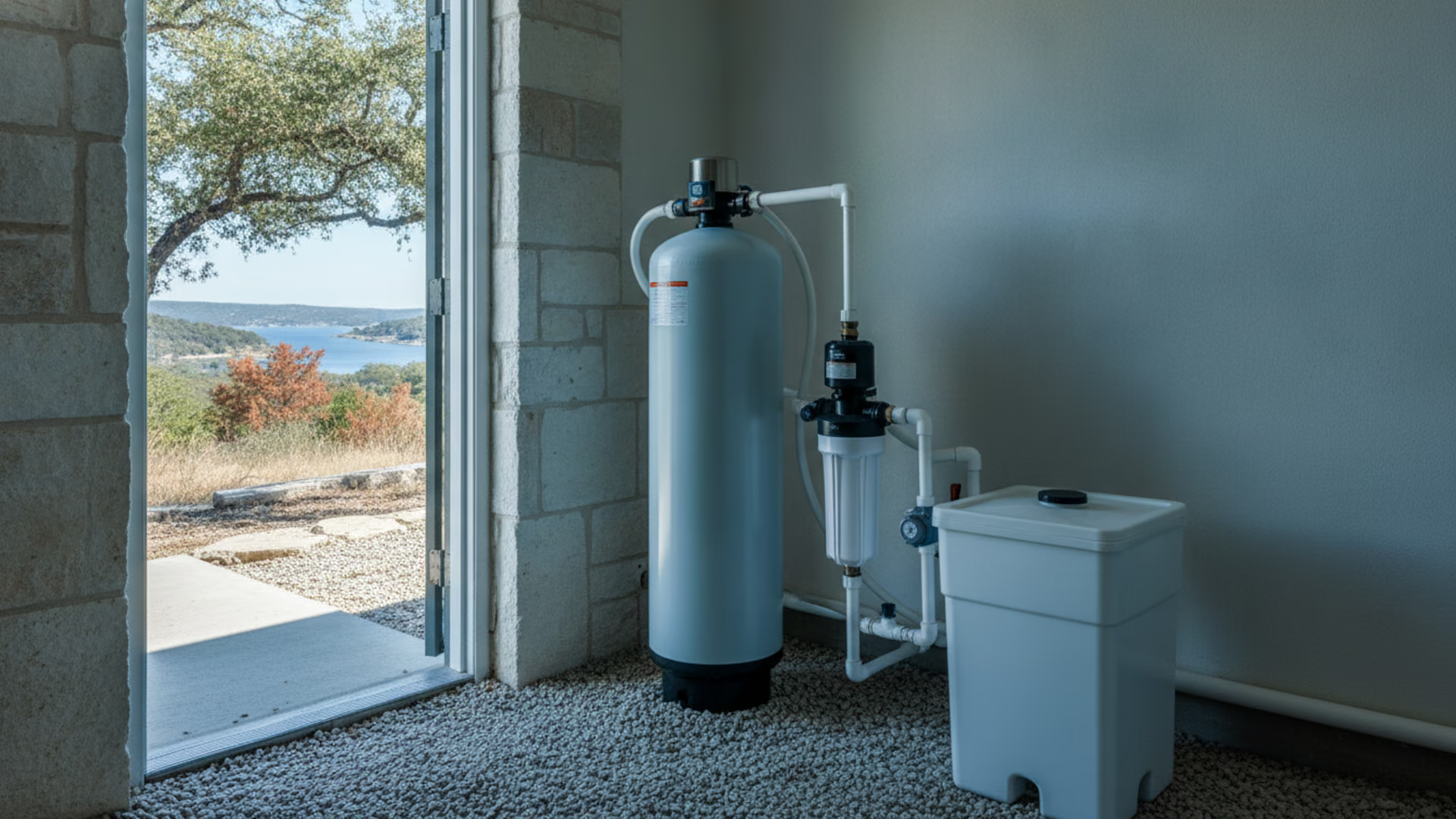
An iron filter for well water is how we clear up the staining Hill Country wells are known for: an orange ring in the toilet bowl that comes back a week after you scrub it, rust streaks under the tub spout, and the laundry comes out yellow no matter what you add to the wash. The other common call is water that looks fine until the shower runs hot and the bathroom smells like rotten eggs. Those are the two things we hear about most from well owners between Round Mountain and Dripping Springs, and they have different causes and different fixes. The iron filter handles the staining. Hydrogen sulfide needs its own treatment or, more often than people expect, no water treatment at all: just a change at the water heater. Sorting out which is which starts with a water test, not a catalog.
One thing up front: iron and manganese are aesthetic problems, not health ones. The EPA's secondary standards (0.3 mg/L for iron, 0.05 mg/L for manganese) mark where staining and metallic taste begin, not where water becomes unsafe. Nobody should buy a sulfur filter out of fear.
Is it the well or the water heater?
If the water smells like rotten eggs, especially hot water, and the cold tap smells fine, the problem is usually inside the water heater. Most tank heaters carry a magnesium anode rod to slow corrosion, and in sulfate-rich Hill Country groundwater that rod drives a reaction that turns dissolved sulfate into hydrogen sulfide gas. The tank becomes a small H2S factory the well never sees, and the fix belongs at the heater (a different anode and a tank flush), not in a whole-house filter.
If every tap smells, hot and cold, and the odor is strongest first thing in the morning or at a hose bib near the pressure tank, the gas is coming up the well. That is the case we treat. We check both before recommending anything, and if the well tests clean we say so. The cause-by-cause breakdown lives in our post on why well water smells like rotten eggs; this page is about the fix.
Iron: clear-water, red-water and iron bacteria
Iron shows up three ways, and how it shows up tells us what to install.
Clear-water (ferrous) iron is dissolved. Water runs clear from the tap, then turns orange in a glass left on the counter and leaves orange or rust stains in the toilet and tub wherever it sits and meets air. It is the most common form in the Trinity and Ellenburger wells around Johnson City and Round Mountain, and the form an air-injection filter is built for.
Red-water (ferric) iron is already oxidized when it reaches the house: the water comes out tinted and the sediment prefilter turns orange in weeks. A well pushing ferric iron nearly always pushes dissolved iron too, so the answer is still an oxidizing filter with a prefilter ahead of it.
Manganese stains black or dark brown instead of orange: a gray film in the dishwasher, black specks in the faucet aerators, a dark ring in the toilet tank. It oxidizes more slowly than iron and needs the right pH and a catalytic media to drop out; a filter sized for iron alone will pass it.
Iron bacteria fool people. They are not a health risk, but they feed on dissolved iron and leave reddish-brown slime in the toilet tank, an oily sheen on standing water and a swampy smell that gets mistaken for sulfur. They foul filters and softener resin fast, and they call for shock-chlorinating the well and, if they return, a chlorination system that kills them ahead of the filter rather than an air-injection unit that feeds them oxygen.
How an air-injection iron filter works
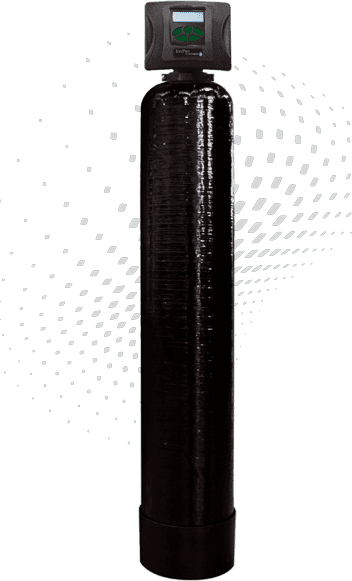
An air-injection iron filter is a single tank with a control valve on top and a pocket of air held at the top of the tank. Incoming well water sprays through that air pocket, oxygen converts dissolved ferrous iron into solid ferric particles, and the media bed below (a catalytic manganese-dioxide or greensand-type media) traps the particles and speeds the reaction. On a schedule the valve backwashes: it lifts the bed, flushes the trapped iron to drain and draws a fresh charge of air. No chemical feed, no salt, no cartridges.
Two numbers decide whether it is the right tool. The first is the iron, manganese and hydrogen sulfide level from the test: air injection handles moderate loads well and struggles as levels climb or when iron bacteria are present. The second is your well's flow rate. Backwash needs several gallons a minute of real flow to lift the bed, and the USGS puts the potential yield of wells in most of Blanco County at only 10 to 25 gallons a minute. On a low-yield well we match the tank to what the pump can deliver, or backwash from a storage tank, rather than set a filter that never fully cleans itself.
Sulfur (hydrogen sulfide) treatment
Worth knowing
Hydrogen sulfide is a gas that leaves the sample bottle as fast as it leaves the tap, so we test for it on site rather than trusting a lab number taken hours later. What we find sets the approach.
Low levels oxidize and drop out in the same air-injection tank that handles iron: oxygen turns H2S into elemental sulfur, the media catches it, backwash sends it to drain. Moderate levels get a dedicated sulfur filter loaded with catalytic carbon, which converts and adsorbs the gas in one bed. Heavy loads, or sulfur combined with high iron, manganese or iron bacteria, get chlorination-retention-filtration: a feed pump doses chlorine ahead of a retention tank that gives it contact time, a backwashing filter removes the precipitate, and a carbon tank strips the leftover chlorine so the house never tastes it. More equipment, but the one method that handles everything at once on a heavily loaded well.
Why your softener can't do this alone
A water softener exchanges hardness for sodium on resin beads, and those beads pull some dissolved iron too (which sounds helpful until the iron oxidizes inside the tank and coats the resin). Above roughly 0.3 mg/L the resin fouls, capacity drops, and the softener starts passing both hardness and iron. Resin cleaners buy time; they do not fix it. The right order of tanks on a Hill Country well is a sediment prefilter, then the iron filter, then the softener (demand-initiated regeneration if you are on septic, as Texas requires), then UV if bacteria are a concern. That is the layout we build as part of a complete well water treatment system.
Testing and sizing
Every recommendation starts with a water test: total and dissolved iron, manganese, hydrogen sulfide, pH, hardness and a flow-rate check at the pressure tank. The pH matters more than people expect. Below about 6.8, iron oxidizes slowly and an air-injection filter underperforms until the water is neutralized. Our water testing page covers what we measure and how. Nobody can size an iron filter from a phone description of a stain; we test, show you the numbers, and write the free estimate from them.
Where we see it most
Round Mountain and Johnson City (Blanco County). The USGS county-wide survey found iron above 0.3 mg/L in 45 percent of the wells it sampled for it and sulfate over 250 mg/L in 18 percent, and the groundwater district flags the Middle Trinity for hardness and odors. Deep Ellenburger wells run hard and often carry iron; the shallower Glen Rose and Hensell wells are where the sulfate and sulfur smell come from. Summer drawdown makes both worse as pumps pull from deeper in the well.
Marble Falls and Horseshoe Bay (Llano Uplift). Most Horseshoe Bay homes are on the city's treated Lake LBJ water, so the iron calls come from ranch tracts south of TX-71 and around Marble Falls on Ellenburger or Hickory sandstone wells. Hickory water in particular runs iron above the secondary limit, and some Hickory wells also carry radium (a separate treatment question we will raise if your test suggests it).
Dripping Springs (Hays County). Glen Rose evaporites push sulfate and magnesium up in Middle Trinity wells, which reads as a bitter taste more often than a smell. Hydrogen sulfide is less documented here, so we test before promising a sulfur filter.
The Leander fringe. The 600-foot-plus Trinity wells on the Nameless Road side are very hard, and the deeper completions can carry iron and a sulfur odor along with sediment: three tanks, not one.
When you are ready to sort out the orange in the toilet or the rotten-egg smell in the shower, call (512) 587-8188 or request a free estimate. We are based in Spicewood, we schedule visits Monday through Friday, 8am to 5pm, and every job is done by Bret himself: the person who tests the water installs the system.